- It's loud. Really loud.
- It's also crystal clear and defined
- Wi-Fi connectivity means hi-res audio
- The app is excellent
- Mic and guitar inputs
- Well-designed control panel
- It's big and heavy
- Karaoke features could be better
- Pricey
I had completely forgotten that JBL was sending me its latest party speaker to review. There were some delays in shipping it to my home in Canada, and it just slipped my mind. Then one day, as if to ask, “remember me?” the 87-pound JBL PartyBox Ultimate landed on my porch in a box the size of a small refrigerator. Standing nearly 4 feet tall, the thing is a beast. And I mean that in the best possible way.
The newest and biggest of JBL’s party speaker lineup, the flagship “Ultimate” couldn’t live up to its name any more than it does. It’s a bona fide party in a box that you can wheel into any room, dance hall, or backyard to turn the place upside down with sound and light. At 1,100 watts RMS, it’s one of (if not the most) powerful party speakers on the market, and it’s the loudest and clearest-sounding I’ve ever heard, without breaking a sweat.
For just $1,700, a casual working DJ would be good to go, out of the box, with this speaker. The Ultimate has built-in lights, mic inputs, sound effects, wheels, and a sturdy handle for lugging it from gig to gig. However, that price isn’t even unreasonable for those just looking to party — it does karaoke, has an excellent companion app, you can plug a guitar into it, and with Wi-Fi connectivity, it can stream hi-res audio and connect to your TV for movie night, too (it even supports Dolby Atmos). It may be huge, and preposterously loud, but after a couple of weeks with the JBL PartyBox Ultimate, I was surprised by its sound quality and its versatility. Let’s dig deeper.
JBL PartyBox Ultimate: design
Did I mention how big the PartyBox Ultimate is? It’s worth repeating. I live in a modest-sized suburban Toronto house, and I had to clear the furniture out of my living room to make space for the unboxing. It comes well-packed in Styrofoam, though, and was relatively easy to get out of the box. If you’re doing it alone, however, follow the instructions printed on the box’s flap (always read the instructions, boys and girls), as it makes it manageable for one person.
The speaker stands at 41.3 inches by 18.9-inches deep and 17.3-inches wide. And, as mentioned, it weighs a hefty 87.1 pounds, roughly 10 pounds heavier than JBL’s outgoing champion, the JBL PartyBox 1000, and more than any other party speaker I’ve ever come across. One public service announcement I can make about the PartyBox Ultimate is to not lift it by yourself. Sure, it has a sturdy plastic handle, the wheels are big and smooth, and it rolls around with ease. But don’t even try to get this thing up or down a set of stairs on your own. Your back will thank you.
The outer shell is a hard, rugged plastic, except for the metal speaker grille emblazoned with the JBL logo. The Ultimate is built like a missile and carries an IPX4 splashproof rating, so pool parties or a little rain (or a spilled cocktail) won’t be a problem. Behind the grille sits an array of six JBL drivers: two honkin’ 9-inch subwoofers, bordered with LEDs that make up the main look of the speaker, two 4.5-inch midrange speakers, and two 2.75-inch tweeters. On the back bottom of the speaker is also a bass port for additional low end. What didn’t carry over from the PartyBox 1000 is the bottom-facing subwoofer, but the Ultimate doesn’t need it. JBL says that the Ultimate has the power to “rock [a space] the size of two basketball courts,” which, from my experience, is 100% true.
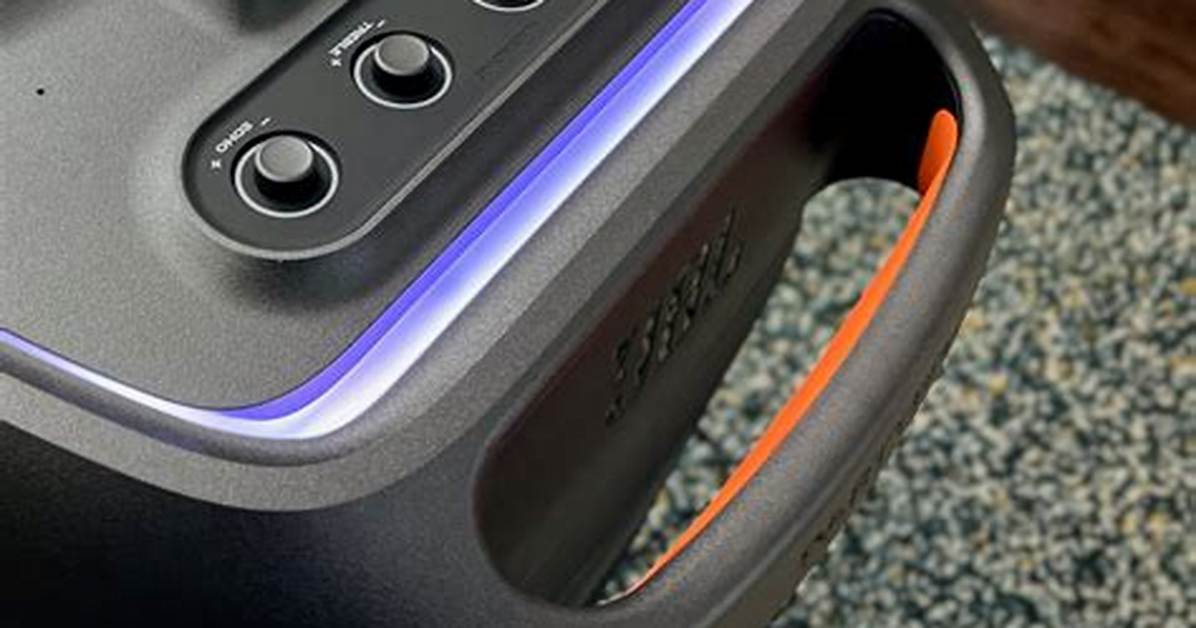
Consistent with a lot of party speakers, all the controls are well-situated on the top panel of the device and are easy to access. Two large dials control volume and lights, and you’ll also find a Bluetooth pairing button, bass boost, and the multi-speaker connect button. Above that is the programmable party pad (more on this later), and above that are volume, EQ, and echo knobs for the main microphone. There’s even a slot where you can mount your smartphone or tablet. Unlike some party speakers, you can control most of the Ultimate’s features from this top panel without the need of the companion app, which is great because you don’t need to rely on having your phone with you all the time.
The PartyBox Ultimate is balanced, articulate, and one of the clearest-sounding speakers I’ve ever heard.
On the back of the Ultimate, behind a rugged protective flap, you’ll find a panel of inputs, including two quarter-inch jacks, one for the main mic and another for mic 2/guitar, as well as a USB-A port for USB sticks and charging devices, a 3.5mm AUX in, and in/out ports for daisy-chaining to other PartyBox Ultimate speakers. There’s also a compartment for storing the power cable, which makes this the perfect time to mention that the Ultimate does not have a battery, so it must be plugged in. But with this kind of juice, that makes sense.
JBL PartyBox Ultimate: connectivity
Getting connected to the PartyBox Ultimate is easy and there are many options. It can connect via Wi-Fi (which is new for JBL party speakers, and rare for party speakers in general) and Bluetooth 5.3, as well as throughline input, AirPlay, Alexa Cast, and Chromecast. The JBL One app is well-designed and is the usual hub for all this connectivity, but Spotify Connect and Tidal Connect support means you can control those streaming services with their apps instead, if you prefer those interfaces. AirPlay also allowed me to connect the Ultimate to my Apple TV 4K for some serious movie sound, as well as access to my music streaming apps installed on it. This is also fun at gatherings because the song details and album art displays on your TV.
I was most interested in checking out the PartyBox Ultimate’s Wi-Fi abilities, though, which not only allowed me to put it to the test with hi-res, lossless quality music thanks to native Tidal, Qobuz, and Amazon Music integration in the JBL One app, but it also let me listen to Dolby Atmos-encoded music tracks (it’s worth noting, though, that if there’s no Wi-Fi access, you won’t be able to play hi-res music at all, as the Ultimate’s Bluetooth does not support it).
The dedicated Wi-Fi connection also meant that phone notifications that would have normally rumbled out of the speaker over Bluetooth stayed confined to my phone — 100-plus decibels of tri-tone text message notifications will not sound pleasing at your party.

